Execution – A Form of Solitaire

Execution is a form of solitaire that was invented by Jeremy Pool and Robin Leland in the early 1960s. The online version of Execution was developed by and is copyrighted by Jeremy Pool under the name of his company (MapRecord Publications).
Execution uses a single well-shuffled deck of 52 cards. In the game, only the suit of a card matters, not its number/rank. Cards are played from the top of the deck, and are laid out onto four positions, left to right, on the table.
Initially, all four positions are empty, with just four blank spaces where the piles will be built up. The goal of the game is to end up, after all the cards have been dealt, with each position containing just the 13 cards of a single suit, and with the suits being in the left-to-right order of spades, hearts, diamonds, and clubs (the same ordering of suits as used in the game of bridge). Here is an example of a winning position:
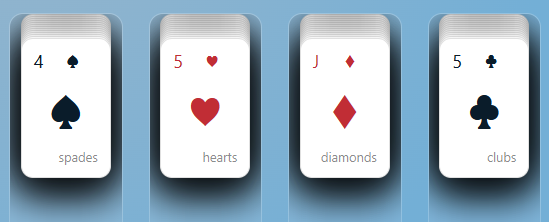
Probably the easiest way to learn to play Execution is to watch a video of an actual game. You can do that here: A game of Execution, with commentary. If you are playing Execution on a computer, you can hold down the <Ctrl> key when you click on the "New Game" button, and the program will play with a deck that is identical to the one shown in the video. This lets you play along with the video, to help you learn the game.
Rules:
- Whenever there are any positions with no cards in them, cards are dealt into those blank positions, from left to right. (Since the game begins with no cards on the table, the first turn in the game always consists of laying out the first four cards from the deck, left to right, into the four positions. If you are playing the online version, this first layout of four cards is automatically done for you when you start a game.)
- If all four positions have cards in them, and there are no moves to be made between positions (see subsequent rules), four cards are dealt from the deck, left to right, on top of the existing piles. A newly dealt card should be placed on top, but not completely covering, the cards beneath it, so you can see the suit of the card underneath each newly dealt card. In the online version of the game, this rule and the next are combined: After four cards have been dealt, the program automatically slides up any cards that are on top of same-suited cards beneath it. A group of same-suited cards is displayed as a single card, except for a tiny top margin for each card, resulting in a display that reflects that you have a group of same-suited cards, rather than just a single card. The more cards in the same-suited group, the thicker that group looks. But whenever such a group is moved from one position to another, the entire same-suited group is moved together, as if it were a single card.
- If a position contains cards of the same suit on top of one another, those cards should be slid together, so they display as if they were a single card. In all cases, a group of cards that are all of the same suit should be treated as a single card. As an example, if the card on top of a particular position is a spade, and, in a turn of laying out four cards, another spade is dealt at that same position, the newly dealt spade should be slid up to cover the spade card(s) directly beneath it. That now-larger group of adjacent spade cards should be treated as a single card if it is moved to another position (as described in subsequent rules). In the description for all subsequent rules, any reference to a ‘card’ means either a single card, or a group of adjacent cards all of the same suit, since such a group is to be treated as if it were a single card. In the online version, you click and drag to move the top group of same-suited cards from one position to a different position, one whose top card matches the suit of the card(s) being moved. Even if you select a card that is not in the top-most group in a particular position, the program knows that only the top, same-suited group of cards can be moved, and the move that will occur is always of that top-most group, even if the card shown during the dragging operation is from a lower-down group in the position. If you attempt an illegal move, for example moving a group of one suit into a position whose top card is of a different suit, the program will simply ignore the move request. Also, in the online version of the game, there is an "Undo" button, which is only enabled after moving cards from one position to another with a dragging operation. Clicking "Undo" will undo the very last drag operation, so if you realize that you made an unwise move, you have a chance to correct your mistake. However, you can only undo the most recent move operation; you cannot undo earlier moves.
- After a set of four cards are dealt, each top card can be moved to a different position, by moving that card (or cards, if the top set of cards are a same-suited group) to the top of any other position whose top card is of that same suit, where the moved cards will be ‘merged’ with the target position’s top card (since, in any position, all adjacent cards of the same suit are treated as a single card).
- After the dealing-out of the initial four cards (to start the game), typically one or more of the positions will contain a card that does not match the desired suit for that position. (The only exception to this is if the first four cards are ♠, ♥, ♦, and ♣, in that order – a very lucky start!) That first (bottommost) card is referred to as the ‘base card’ for the position. Since a winning game requires all the cards in each of the four positions to be of the suit specified for that position, it is important to move any incorrect base card away from its current position. This can be done by moving that card to a different position, one whose top card matches that of the base card being moved. Once moved, the position previously occupied by the base card will be empty, and, according to an earlier rule, the next dealing of cards from the deck will just fill in the blank position (or positions, if more than one position has been emptied out by the previous turn’s moves).
- When moving cards between positions, it is not required to continue moving until no further moves are possible. In other words, you are allowed to leave more than one position with top cards of the same suit. As an example, if the top cards of the four positions are ♣, ♠, ♠, and ♦, you can opt to stop moving cards at that point and proceed to deal out four new top cards. So even though the spade in position 2 could be moved to position 3 (or vice versa), you are not required to do this. This ability to leave two or more positions with top cards of the same suit is primarily of interest when one of the four positions is empty. So, for example, if the top cards for the four positions are ♠ - [blank] - ♥ - ♥ [that is, the second position has no cards in it], then you might not want to merge the hearts into one of the last two positions, particularly if underneath those two hearts are the desired base cards for those two positions (♦ and ♣). That way, when you deal out a card into the second (empty) position, if the desired ♥ is not dealt, but, unfortunately, a ♦ or
♣ is dealt, you can move that unfortunate card out by moving one of the two heart cards (merging it with the other heart card), thereby revealing the ♦ or
♣ underneath, allowing the just-dealt ♦ or
♣ to be moved over to another position. This gives you the opportunity to again try dealing a card into the blank second position, still hoping for a ♥.
Strategy:
The game falls naturally into three phases:
- Establishing correct base cards for the four positions. (In the online version of the game, any position that contains the correct base card will show a blue circle around the suit symbol above the position. This helps you to quickly assess which positions contain or do not contain their correct base card.)
- Rearranging non-base cards so that each position contains only one card (or group of identically-suited cards), and there are no non-base cards left at any position.
- Playing subsequent turns of laying out four cards onto the four positions, and rearranging, as much as possible, so that there are no non-base cards at any position. More often than not, a set of four newly dealt out top cards can be rearranged so that the cards all end up in their desired suit position. But sometimes the newly dealt set of four cards results in some top cards that cannot be rearranged to their desired ‘home’ position. In that case, four new cards are dealt and, based on the arrangement of suits, it may be possible to unscramble the various piles so that you are left with just cards of the desired suit in each of the four positions.
In the online version, when all the cards have been dealt out and no more moves between positions can be made, the program shows a notification, informing you either that you have won or that you have lost. If you win, some celebratory fireworks will be displayed, and, if you have toggled the sound icon at the upper right (just to the right of the "New Game" button), a trumpet fanfare will also be played. The winning/losing notification also includes a checkbox ("Replay same deck on next game"). If you turn that checkbox on, then, when you start the next game (by clicking the "New Game" button), the deck that will be used will be identical to the deck used in the previous game. In other words, the cards will be in exactly the same order. This gives you a chance to try replaying a game you lost, to see if you can make some different moves and get a better result.
©2026 MapRecord Publications